Reading group

Ideas examined in the open.

From 2024, the tutorial reading group holds bi-weekly meetings featuring a detailed three-hour tutorial talk presented by one of our group members, discussing state-of-the-art research topics that they are interested in. Each presentation is followed by a Q&A and discussion session on the topic.

Anyone can join by request. If you are interested and have something to discuss, please feel free to get in touch with staff in Trustworthy ACPS Lab.

Tutorial sessions are held online through Microsoft Teams. The second round was scheduled for 9am UK time and 4pm Beijing time.

Tutorial series

Recent and scheduled sessions.

23 sessions

10/10/2024, 9am UK time, 4pm Beijing time

Adversarial Data Distortion and Impact on Deep Vision Perception for ADS/ADAS

Zixiang Wei (University of Warwick)

24/10/2024, 9am UK time, 4pm Beijing time

Tutorial 2

Meilin Zhu (Chinese Academy of Sciences)

07/11/2024, 9am UK time, 4pm Beijing time

Tutorial 3

Jiaxu Liu (The University of Liverpool)

21/11/2024, 9am UK time, 4pm Beijing time

Tutorial 4

Shuaitong Liu (Chinese Academy of Sciences)

05/12/2024, 9am UK time, 4pm Beijing time

Tutorial 5

Xinmiao Huang

19/12/2024, 9am UK time, 4pm Beijing time

Tutorial 6

Yi Zhang (University of Warwick)

02/01/2025, 9am UK time, 4pm Beijing time

Tutorial 7

Jinyong Wang (Visitor at The University of Liverpool)

16/01/2025, 9am UK time, 4pm Beijing time

Tutorial 8

Zhenglin Huang (The University of Liverpool)

06/02/2025, 9am UK time, 4pm Beijing time

Tutorial 9

Zhen Zhang (Chinese Academy of Sciences)

20/02/2025, 9am UK time, 4pm Beijing time

Tutorial 10

Zhuoyun Li (The University of Liverpool)

06/03/2025, 9am UK time, 4pm Beijing time

Tutorial 11

Zixia Wang (University of Exeter)

20/03/2025, 9am UK time, 4pm Beijing time

Tutorial 12

Qisong He (The University of Liverpool)

03/04/2025, 9am UK time, 4pm Beijing time

Tutorial 13

Yuhang Chen (University of Warwick)

17/04/2025, 9am UK time, 4pm Beijing time

Tutorial 14

Zhen Chen (The University of Liverpool)

24/04/2025, 9am UK time, 4pm Beijing time

Tutorial 14

Jiacheng Pi (The University of Science and Technology of China)
08/05/2025, 9am UK time, 4pm Beijing time

Tutorial 15

Ruizhi Zhong (The University of Science and Technology of China)

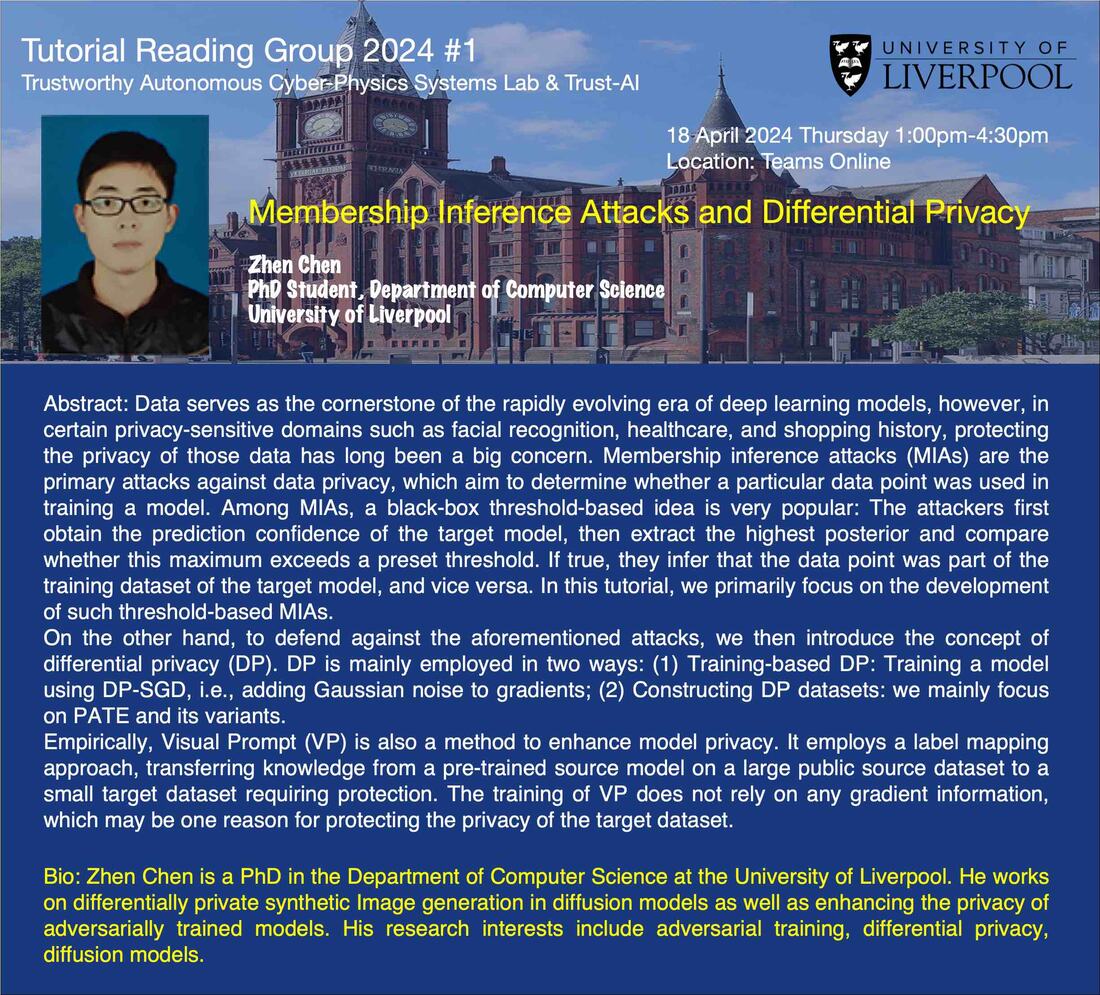
13:00-16:30, Thursday, 18/April/2024

Membership Inference Attacks and Differential Privacy

Zhen Chen (University of Liverpool)

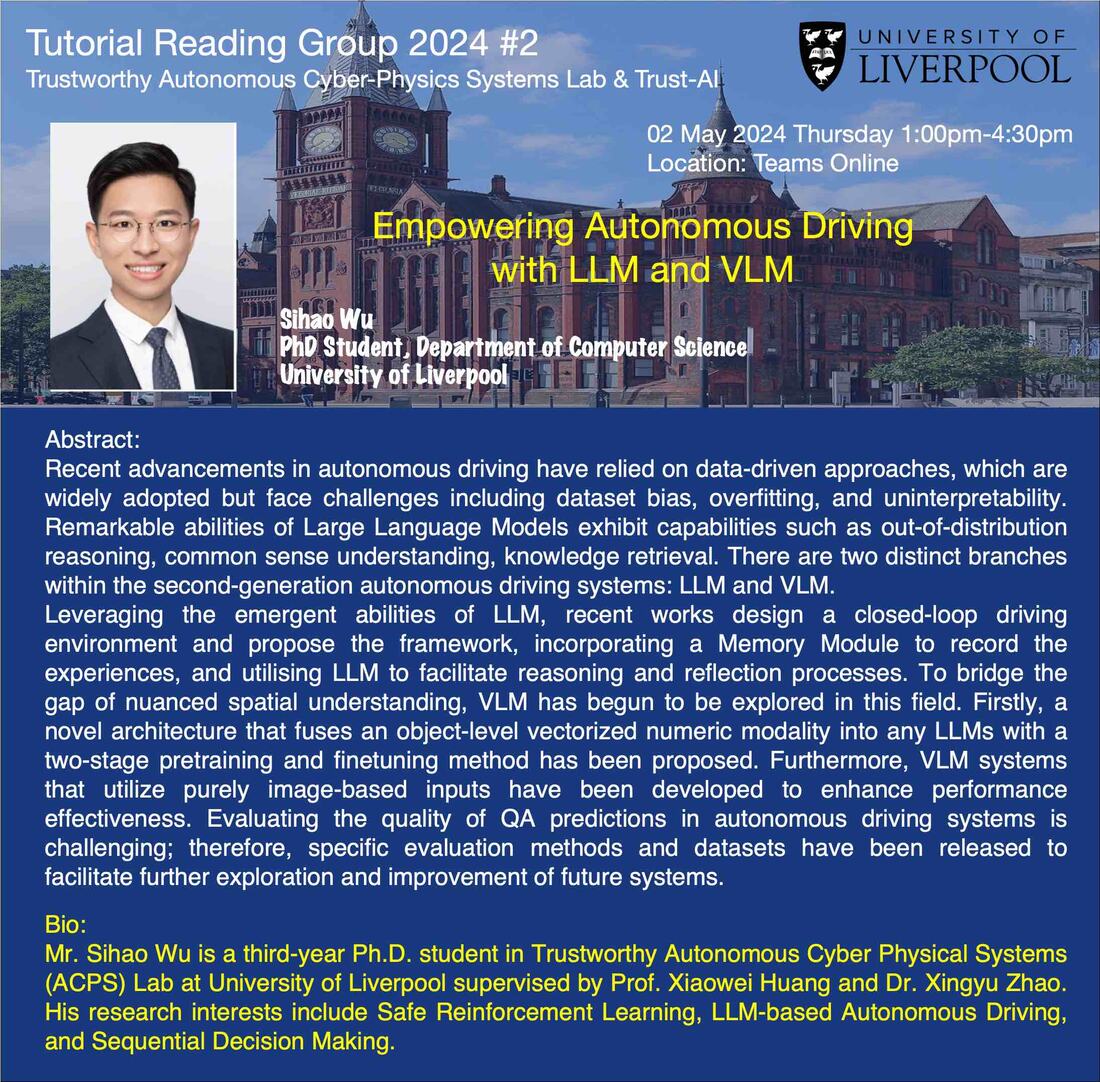
13:00-16:00, Thursday, 02/May/2024

Empowering Autonomous Driving with LLM and VLM

Sihao Wu (University of Liverpool)

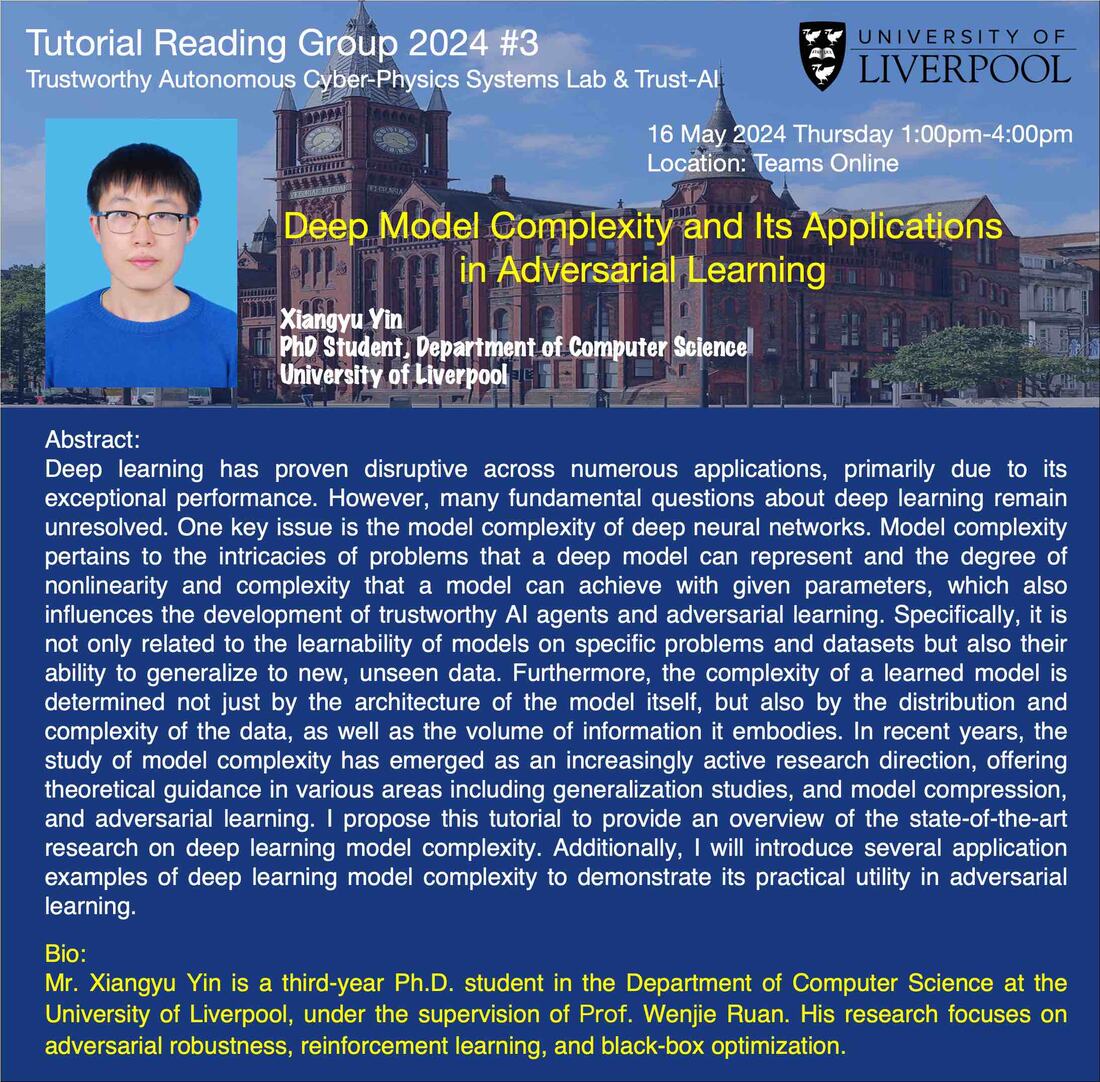
13:00-16:00, Thursday, 16/May/2024

Deep Model Complexity and Its Applications in Adversarial Learning

Xiangyu Yin (University of Liverpool)

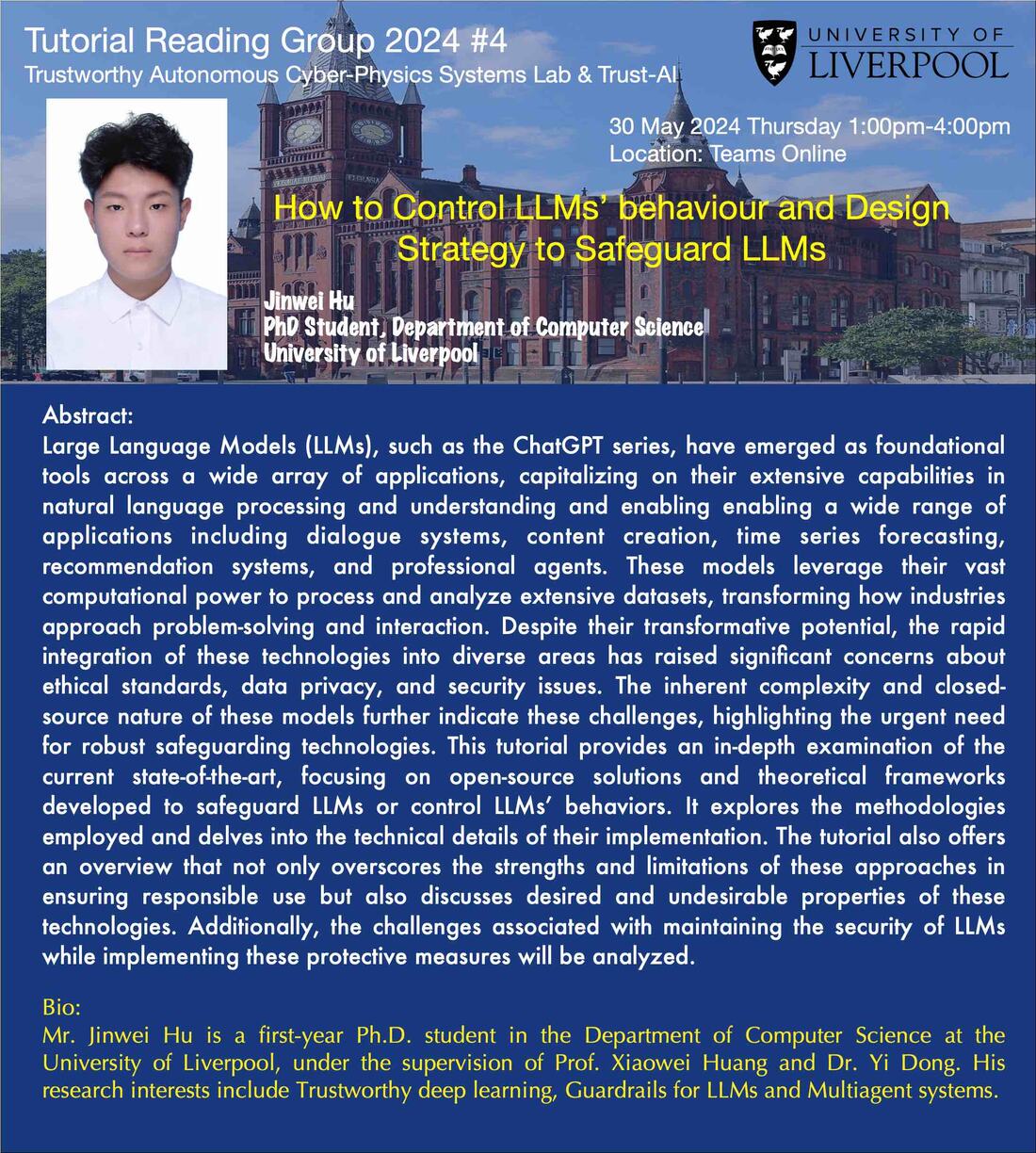
13:00-16:00, Thursday, 30/May/2024

How to Control LLMs’ behaviors and Design Strategy to safeguard LLMs

Jinwei Hu (University of Liverpool)

13:00-16:00, Thursday, 20/June/2024

Exploring Black-Box Global Optimization: From Multi-Arm Bandits to Bayesian Techniques

Fu Wang (University of Exeter)

13:00-16:00, Thursday, 04/July/2024

Exploring Prompt Engineering to Retrieval-Augmented Generation and AI Agents

Yi Qi (University of Liverpool)

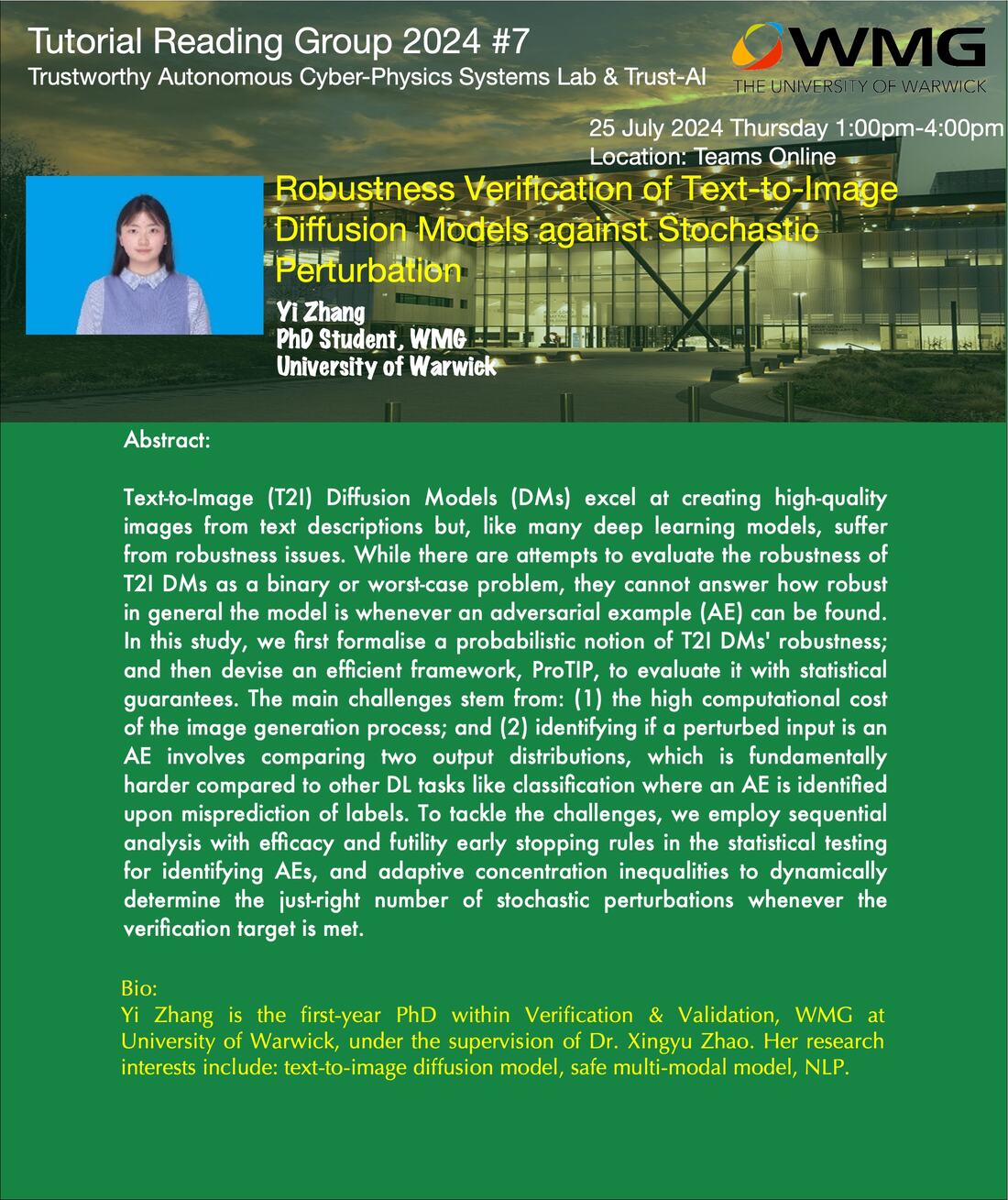
13:00-16:00, Thursday, 25/July/2024

Robustness Verification of Text-to-Image Diffusion Models against Stochastic Perturbation

Yi Zhang (University of Warwick)

Archive

Earlier discussions.

112 sessions

202240 sessions
  1. Inspiring works on NeRFKaiwen Cai
  2. Improving Task-free Continual Learning by Distributionally Robust Memory EvolutionSihao Wu
  3. COPA: CERTIFYING ROBUST POLICIES FOR OFFLINE REINFORCEMENT LEARNING AGAINST POISONING ATTACKSRonghui Mu
  4. Learning to coloring: DRL method based on GNNZhiwei Shan
  5. Adaptive Spiking Neural NetworkDengyu Wu
  6. Certifiably Adversarially Robust Detection of Out-of-Distribution DataChi Zhang
  7. Formal analysis of Deep Binarized Neural NetworksSahar Alzahrani
  8. Delving Deep Into Label SmoothingYi Qi
  9. Weight-based Semantic Testing Approach for Neural NetworkAlshareef Amany
  10. Adversarial robustness via robust low rank representationsFu Wang
  11. SAFER: A Structure-free Approach for Certified Robustness to Adversarial Word SubstitutionsSiqi Sun
  12. Generalisation to Flat\Sharp MinimaTianle Zhang
  13. Certified Patch Robustness Via Smoothed Vision TransformersPeipei Xu
  14. The Limitations of Large Width in Neural Networks: A Deep Gaussian Process PerspectiveXiangyu Yin
  15. Understanding Adversarial Robustness of Vision Transformers via ODEsZheng Wang
  16. Feature and Weight Regularization for Deeper Graph Neural NetworksJiaxu Liu
  17. How Metric Learning improves Classification and RegressionKaiwen Cai
  18. Robustness and Accuracy Could be Reconcilable By (Proper) DefinitionGaojie Jin
  19. Data Augmentation of Reinforcement LearningSihao Wu
  20. Learning Transferable Features from Different DomainsFan Zhou
  21. Cache-based GNN System for Dynamic GraphsHan Yu
  22. POLICY SMOOTHING FOR PROVABLY ROBUST REINFORCEMENT LEARNINGRonghui Mu
  23. Learning What to Defer for Maximum Independent SetsZhiwei Shan
  24. Comparison between Quantised and Spiking Neural NetworkDengyu Wu
  25. Man-in-the-Middle Attack against Object DetectionHan Wu
  26. A Statistical Approach to Assessing Neural Network RobustnessWei Huang
  27. Node Similarity Preserving Graph Convolutional NetworksChi Zhang
  28. Node Similarity Preserving Graph Convolutional NetworksGanlin Liu
  29. A Vision-based Irregular Obstacle Avoidance Framework via Deep Reinforcement LearningYi Qi
  30. Distribution-Aware Testing of Neural Networks Using Generative ModelsAmany Alshareef
  31. Adversarial Robustness Across Representation SpacesFu Wang
  32. SMART: Robust and Efficient Fine-Tuning for Pre-trained Natural Language Models through Principled Regularized OptimizationSiqi Sun
  33. Consistency Regularisation Enabled Semi-supervised Learning in Task of Medical Image AnalysisYanda Meng
  34. Probabilistically Robust Learning: Balancing Average- and Worst-case PerformanceTianle Zhang
  35. Formal Security Analysis of Neural Networks using Symbolic IntervalsPeipei Xu
  36. Intriguing Properties of Vision TransformerZheng Wang
  37. Appending Adversarial Frames for Universal Video AttackXiangyu Yin
  38. Normalizing FlowJiaxu Liu
  39. Transfer Learning for Point CloudsKaiwen Cai
  40. Stealthy and Efficient Adversarial Attacks against Deep Reinforcement LearningSihao Wu
202148 sessions
  1. Certified Adversarial Robustness for Deep Reinforcement LearningRonghui Mu
  2. Link scheduling using graph neural networksHan Yu
  3. Exact Combinatorial Optimization with Graph Convolutional Neural NetworksZhiwei Shan
  4. Exploring Adversarial Attack in Spiking Neural Networks With Spike-Compatible GradientDengyu Wu
  5. Black-box Adversarial Toolbox (BAT): Distributed black-box attackHan Wu
  6. Towards Feature Space Adversarial Attack by Style PerturbationWei Huang
  7. The Dimpled Manifold Model of Adversarial Examples in Machine LearningYanghao Zhang
  8. Patches Are All You Need?Gaojie jin
  9. Verisig 2.0: Verification of Neural Network Controllers Using Taylor Model PreconditioningChi Zhang
  10. Predict Then Propagate: Graph Neural Networks Meet Personalized PageRank’Ganlin Liu
  11. Fooling LIME and SHAP: Adversarial Attacks on Post hoc Explanation MethodsJianqiao Zhang
  12. Bayesian Deep Learning via Subnetwork InferenceAmany Alshareef
  13. Certify or Predict: Boosting Certified Robustness with Compositional ArchitecturesFu Wang
  14. Enforcing Interpretability and its Statistical Impacts: Trade-offs between Accuracy and InterpretabilityEmese Thomas
  15. Towards Robustness Against Natural Language Word SubstitutionsSiqi Sun
  16. Regression of Instance Boundary by Aggregated CNN and GCNYanda Meng
  17. Attribute-Guided Adversarial Training for Robustness to Natural PerturbationsTianle Zhang
  18. Towards verifying robustness of neural networks against a family of semantic perturbationsPeipei Xu
  19. On the Adversarial Robustness of Visual TransformersZheng Wang
  20. Towards real-time photorealistic 3D holography with deep neural networksDengyu Wu
  21. Reducing DNN Properties to Enable Falsification with Adversarial AttacksRonghui Mu
  22. Heterogeneous Graph Matching Networks for Unknown Malware DetectionGanlin Liu
  23. Distributed scheduling using graph neural networksHan Yu
  24. Depth estimation from monocular images and sparse radar dataKaiwen Cai
  25. Adversarial Detection: Generating adversarial patch is as easy as drag and dropHan Wu
  26. RobOT: Robustness-Oriented Testing for Deep Learning SystemsWei Huang
  27. Robust Overfitting may be mitigated by properly learned smootheningYanghao Zhang
  28. Learning Diverse and Discriminative Representations via the Principle of Maximal Coding Rate ReductionGaojie Jin
  29. Learning to Simulate Complex Physics with Graph NetworksChi Zhang
  30. How powerful are graph neural networks?Zhiwei Shan
  31. Robust feature learning for adversarial defense via hierarchical feature alignmentAmany Alshareef
  32. Towards Interpretable Deep Neural Networks by Leveraging Adversarial ExamplesJianqiao Zhang
  33. Gradient-Guided Dynamic Efficient Adversarial TrainingFu Wang
  34. Benchmarking and Survey of Explanation Methods for Black Box ModelsEmese Thamo
  35. HopSkipJumpAttack: A Query-Efficient Decision-Based AttackSiqi Sun
  36. An Image is Worth 16x16 Words: Transformers for Image Recognition at ScaleYanda Meng
  37. Evidential deep learning for uncertainty estimationTianle Zhang
  38. Boosting robustness certification of neural networksPeipei Xu
  39. Fundamental Tradeoffs between Invariance and Sensitivity to Adversarial PerturbationsZheng Wang
  40. Particle Filter Recurrent Neural NetworksKaiwen Cai
  41. Certifying Robustness of Convolutional Neural NetworksRonghui Mu
  42. Adversarial Robustness of Spiking Neural NetworksDengyu Wu
  43. From MODEL to MOSFET: Why models fail to survive on edge devices?Han Wu
  44. Dropout InterpretabilityGaojie Jin
  45. Breaking Certified Defenses and VerifierYanghao Zhang
  46. Reliability Assessment Model for DL system through Robustness Evaluation and Operational TestingWei Huang
  47. Verifying Recurrent Neural Networks using Invariant InferenceChi Zhang
  48. Auto-Encoding Variational BayesHan Yu
202024 sessions
  1. Generating 3D Adversarial Point CloudsRonghui Mu
  2. Uncertainty-Aware Semi-Supervised LearningYanda Meng
  3. "(De)Randomized Smoothing for Certifiable Defense against Patch Attacksn"Peipei XU
  4. "NetVLAD: CNN architecture for weakly supervised place recognition"Kaiwen Cai
  5. Energy Efficient Spiking Neural NetworksDengyu WU
  6. Boosting Operational DNN Testing Efficiency through ConditioningWei Huang
  7. In-memory Processing based on Time-domain CircuitYuyao Kong, Southeast University
  8. How does Weight Correlation Affect the Generalisation Ability of Deep Neural NetworksGaojie Jin
  9. Rate-Distortion Optimization Guided Autoencoder for Isometric Embedding in Euclidean Latent SpaceHan Yu
  10. POPQORN: Quantifying Robustness of Recurrent Neural NetworksChi Zhang, University of Exeter
  11. Sparse Adversarial Perturbations for VideosRonghui Mu, University of Exeter
  12. Radio Frequency Fingerprint Identification for LoRa Using Deep LearningGuanxiong Shen
  13. ‘introduction to Spiking Neural Networks’Dengyu Wu
  14. ‘Certified Defenses for Adversarial Patches’Peipei Xu.
  15. ‘Adversarial Training for Free!’ and ‘Fast is better than free: Revisiting adversarial training’Fu Wang, University of Exeter
  16. Practical Verification of Neural Network Enabled State Estimation System for RoboticsWei Huang
  17. `The Implicit and Explicit Regularization Effects of Dropout'Gaojie Jin
  18. Safety Certification of Deep LearningXiaowei Huang
  19. Rate-Distortion Optimization Guided Autoencoder for Isometric Embedding in Euclidean Latent SpaceHan Yu
  20. Introduction to Spiking Neural NetworksDengyu Wu
  21. Certified Adversarial Robustness via Randomized SmoothingPeipei Xu.
  22. backdoor attack on tree ensemblesWei Huang.
  23. predicting generalisation of deep neural networksGaojie Jin
  24. spectral analysis of convolutional neural networksXinping Yi.